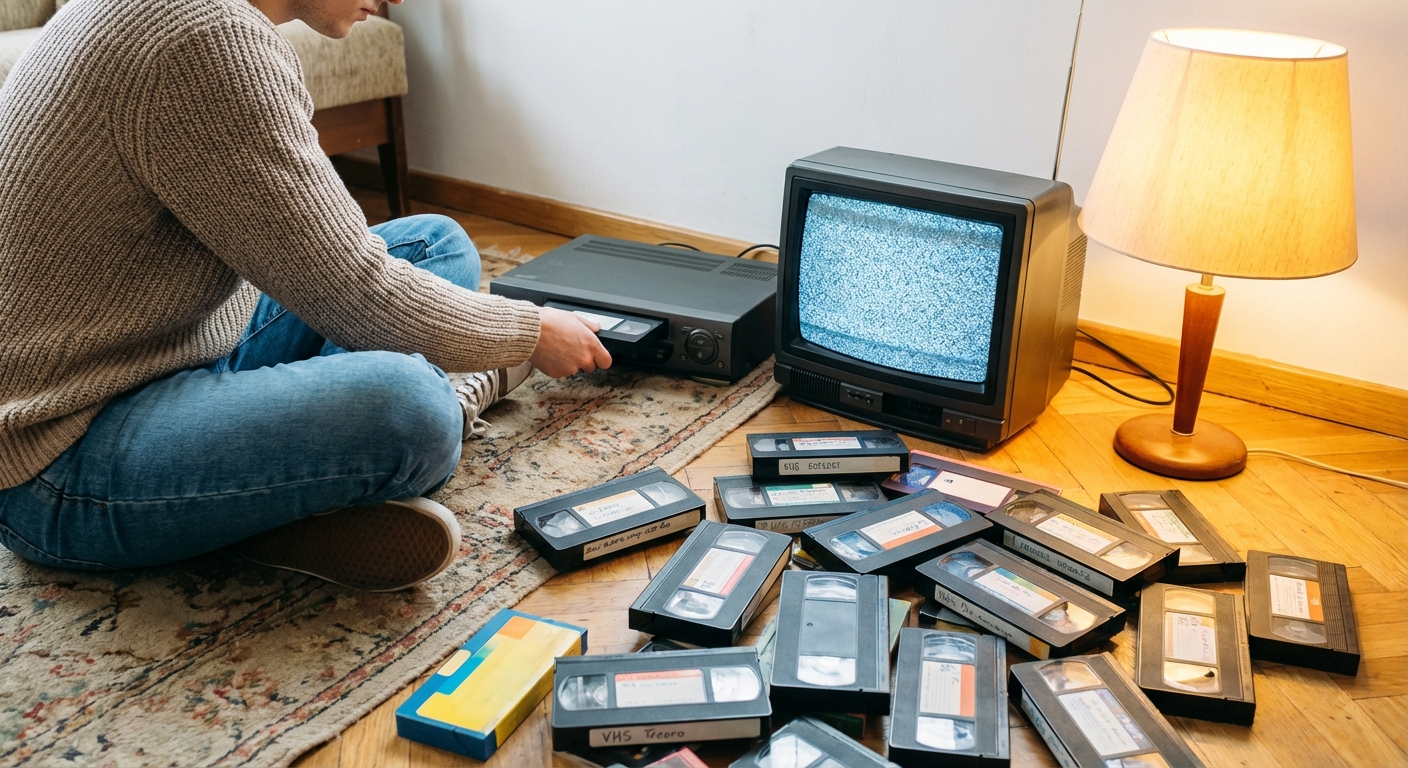
Before streaming queues and buffering wheels, movie night meant a trip to the video store and the satisfying clunk of a VHS cassette dropping into a VCR. That whirr of motors, the faint buzz on the CRT, the FBI warning—this was the prelude ritual to cinema.
When Movie Night Lived Inside a Plastic Brick
VHS (Video Home System), launched by JVC in the late 1970s, helped define home entertainment in the 80s and 90s. It won the infamous VHS vs Betamax format war not by being the best technically, but by being good enough, cheap enough, and recording long enough to capture an entire movie.
Today, those chunky black rectangles are making a comeback—not just as nostalgia props, but as a full-blown collector hobby.
A Quick Rewind: How VHS Won the Living Room
Betamax vs VHS: The Tape War
Sony’s Betamax arrived first in 1975, boasting better picture quality. VHS followed in 1976 with a simple advantage: longer recording time.
- Early Betamax: about 1 hour recording
- Early VHS: up to 2+ hours, later 6+ with EP/LP modes
Consumers wanted to record full movies and sports games more than they wanted slightly crisper resolution. Videotape rental chains loved the lower cost of VHS tapes and decks. Studios liked the format that spread faster.
By the mid-80s, the war was over. "VCR" might have meant either technically—but in living rooms, they were almost all VHS.
Inside the Beast: How VHS Actually Works
A VHS cassette is a mechanical marvel disguised as an ugly plastic box.
The Tape
- Width: ½ inch magnetic tape
- Speed: ~1.31 inches/second in standard play
- Storage: Up to several hundred meters of tape spooled on dual hubs
The VCR Mechanism
When you insert a tape:
- The machine pulls the tape out of the cassette using loading arms.
- It wraps the tape around a spinning drum head at an angle.
- The drum head rotates at high speed (~1800 rpm), and tiny heads read diagonal stripes of video data.
This system, called helical scan recording, squeezes a full video signal onto relatively slow-moving tape.
Tracking, Noise, and That Classic VHS Look
VHS was never about perfection. It was about "good enough to forget you were watching tape." Its signature traits:
- Soft resolution (roughly 240 lines)
- Occasional tracking noise at the bottom of the image
- Color bleed and a slightly washed-out look
For many of us, this is what movies look like in memory.
Why People Are Collecting VHS Again
You’re not imagining it: VHS prices are rising, especially for horror, direct-to-video oddities, and big-box rentals.
1. Artwork and Packaging
Rental-era VHS covers were bold, sometimes unhinged, and almost always more dramatic than the actual film. Oversized clamshell boxes from the 80s are especially prized:
- Painted artwork instead of Photoshop collages
- Hilariously overblown taglines
- Rating stickers, "Previously Viewed" labels, and worn corners that tell a whole story
2. The "Video Store Cut"
Some films only ever had certain edits or dubs released on VHS:
- Alternate cover art
- Different soundtracks
- Pre-movie trailers and bumpers that never made it to DVD or Blu-ray
Collectors cherish these as tiny time capsules of a specific cultural moment.
3. The Hunt
VHS collecting is fun precisely because it's not neat and catalogued:
- Finding a long out-of-print slasher in a cardboard box at a yard sale
- Trading tapes in fan communities and horror conventions
- Rescuing an entire box of ex-rental tapes from the trash
One collector’s story: a forgotten cardboard carton in a closing video store’s back room, filled with banned and ultra-rare exploitation titles—acquired for the promise of "get this out of here today."
Starting Your First VHS Collection: A Friendly How-To
Step 1: Decide Your Flavor
You don’t need everything. In fact, you can’t—VHS had an absurdly huge catalog. Instead, pick a lane:
- 80s horror and slashers
- Kids’ cartoons and taped-off-TV specials
- Action movies with over-the-top cover art
- Obscure documentaries and oddities
Or go micro-niche: only tapes with "3 for $5" rental stickers, only ex-rentals from your hometown chain, etc.
Step 2: Find a Working VCR (or Two)
Look for:
- A front-loading VHS deck from the late 90s or early 2000s
- Brands like JVC, Panasonic, Mitsubishi, or Sony
- A 4-head Hi-Fi stereo model if you can
Ask sellers to:
- Confirm eject and play functions
- Show a photo with a tape playing on-screen if possible
If you're lucky, you’ll inherit one from a relative who never quite got around to throwing it out.
Step 3: Learn Basic Tape & VCR Care
- Always rewind tapes fully before storage
- Store tapes upright, like books, away from magnets and heat
- Clean your VCR heads with a proper cleaning tape or have it serviced periodically
If a tape is jammed, resist the urge to yank: gently remove the case and free the tape instead.
Where to Score VHS Gems
Skip the overpriced "retro" boutiques initially and focus on:
- Thrift stores: Often price tapes at "fill a bag" rates
- Yard/garage sales: Especially in older neighborhoods
- Library sales: Quiet goldmines for educational and kids’ content
- Local classifieds: People giving away boxes of tapes "for free if you pick up"
Online, look to:
- Fan groups on social media
- Niche horror or cult-movie forums
- Auction sites—but only once you know fair pricing
Watching VHS in the Digital Age
Hooking up a VCR is easier than it looks:
- Use the classic yellow (video), white/red (audio) RCA cables.
- Connect them to any TV with composite inputs (or via an AV-to-HDMI converter).
- Don’t expect HD. Lean into the fuzz.
The fun part is embracing the whole analog ritual:
- The tracking adjustment dial
- The on-screen blue background and timer
- The pre-roll trailers and "Coming Soon to Home Video" bumpers
Those "flaws" are now the main attraction.
Why VHS Still Feels So Comforting
VHS is the home-movie equivalent of comfort food:
- It’s slower and chunkier than it needs to be.
- It limits choice to what’s on your shelf.
- It invites you to watch something all the way through, just like the old days.
In a world of infinite streaming options, there’s something grounding about physically picking a tape, committing to the choice, and hearing the deck spin up. It’s a reminder that entertainment used to involve leaving the house, negotiating with other people, and accepting that the movie might already be rented out.
So, be kind—rewind your expectations. Your VHS collection doesn’t need to be pristine or valuable to anyone else. It just needs to feel like your own private video store, ready for one more late fee–free movie night.