Long before gacha mechanics and push notifications, we had handheld game consoles that ran on AA batteries and pure imagination. They lived in school backpacks, under pillows, and in the back seats of station wagons. Their screens were small, their soundtracks beeped instead of boomed, and yet they contained universes.
Pocket Worlds Before Smartphones
Handhelds are a special branch of retro tech: intimate, a little fragile, and deeply personal. They remember our save files and thumbprints. Let’s take a playful tour through their history, their quirky tech, and the collector culture that’s turned these pocket-sized portals into prized artifacts.
The Primitive Pioneers: Single-Game Wonders
Mattel Electronics & LED Magic
In the late 70s, devices like Mattel Football and Auto Race were marvels of minimalism:
- Tiny red LEDs stood in for players and cars
- Simple beeps indicated passes, crashes, and touchdowns
- Logic was hardwired—no cartridges, no updates, no DLC
Despite their simplicity, they were wildly popular, proof that interactivity itself was the real novelty.
Nintendo’s Game & Watch Series
Launched in 1980, Game & Watch turned spare pockets into game cabinets:
- LCD screens with static backgrounds and moving elements
- Each unit hosted a single game (sometimes two) plus a clock
- Designed by Gunpei Yokoi, whose "lateral thinking with withered technology" philosophy would shape handhelds for decades
Iconic models like Octopus, Parachute, and the dual-screen Donkey Kong introduced layouts that would echo all the way to the Nintendo DS.
The Eight-Bit Explosion: Game Boy vs. The World
Game Boy: The Green-Tinted Giant
Released in 1989, the Nintendo Game Boy shouldn’t have worked on paper:
- 8-bit CPU based on the Z80 family
- 160×144 pixel dot-matrix display
- Monochrome, greenish screen with no backlight
And yet it absolutely dominated.
Why?
- Battery life: Up to 10–15 hours on 4 AA batteries
- Durability: Survived everything from backpack abuse to a Gulf War bombing (a famously burned unit still works)
- Library: Tetris, Pokémon, Zelda, Mario, and countless third-party hits
It turned "portable gaming" from novelty to necessity.
The Challengers: More Power, Less Staying Power
Sega Game Gear (1990)
- Color backlit screen
- Master System–like hardware
- Gorgeous for the time… and ate 6 AA batteries in hours
Atari Lynx (1989)
- True 16-bit graphics
- Hardware scaling and rotation
- Technically amazing, commercially niche
Cooler specs didn’t beat cheaper, sturdier, and good-enough Game Boy tech. Sound familiar?
Technical Charm: What’s Inside These Little Bricks?
Take the original Game Boy as the archetype.
Core Components
- CPU: Custom Sharp LR35902 (~4.19 MHz)
- RAM: A few kilobytes for system and video memory
- Cart Slot: ROM cartridges that sometimes included their own extra chips or memory
Display Quirks
The reflective LCD:
- Refreshes line by line from top to bottom
- Has ghosting, so fast movement leaves trails
- Is almost invisible in the dark without an external light
Yet that ghosting and pixel grid are now part of the aesthetic. Fan-made shaders for emulators even simulate it.
Sound
Basic but iconic:
- 2 pulse wave channels
- 1 wave channel
- 1 noise channel
Limitations forced composers to write tight, memorable hooks—hence why you can still hum Tetris music on command.
The Culture of Carry: How Handhelds Changed Play
Always On, Always Yours
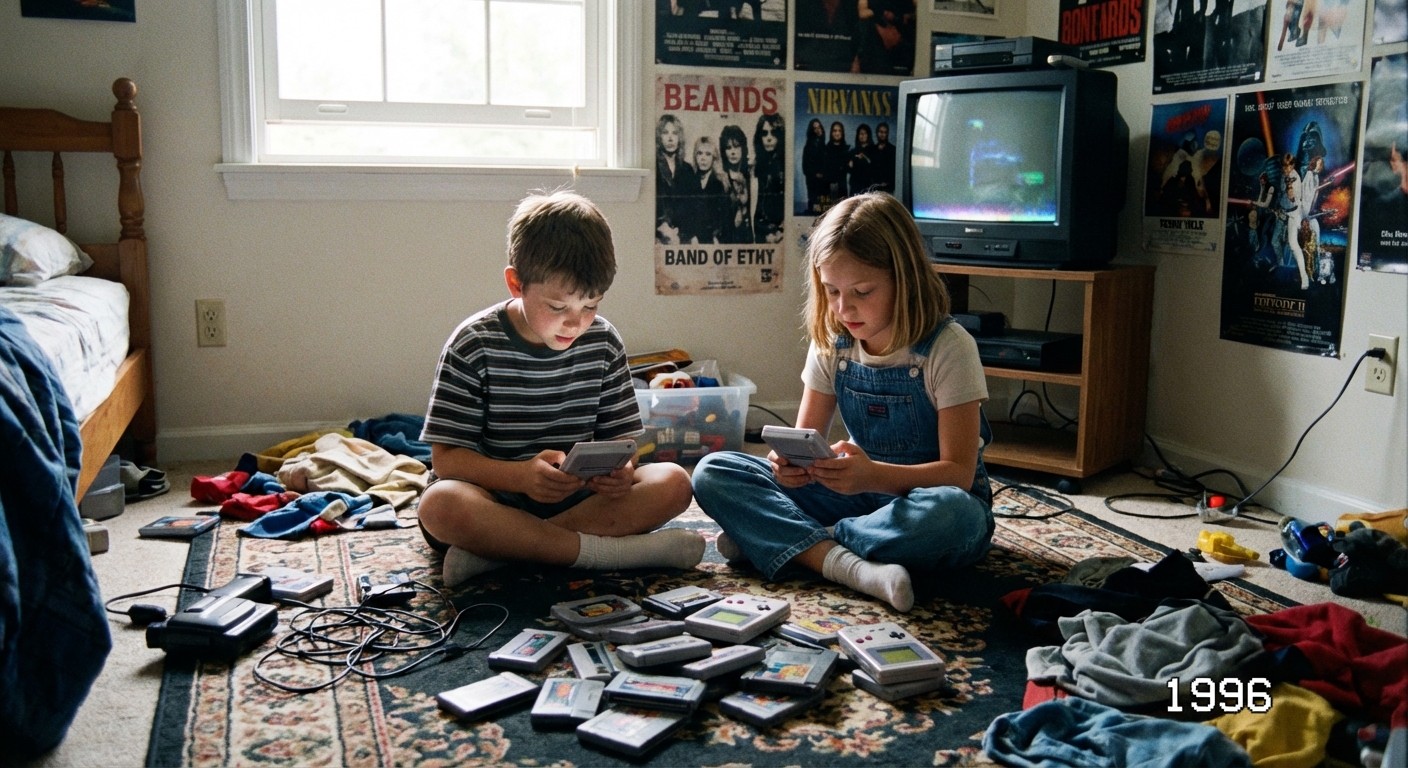
Unlike the family TV or the shared PC, handhelds were personal:
- Your save files
- Your scribbles and stickers on the shell
- Your link cables and secret high scores
They turned gaming from a scheduled activity into something that could happen in line at the grocery store.
Social (and Slightly Illicit) Gaming
- Trading Pokémon via Link Cable at recess
- Sneaking Game Boys into class under the desk
- Passing a handheld back and forth on long road trips
These devices taught a whole generation the fine art of playing with the sound off but the volume in your head turned all the way up.
Collector Anecdotes: Pocket Grails and Flea-Market Finds
The Sun-Faded SP
One collector tells of spotting a Game Boy Advance SP at a garage sale, bleached nearly pink from sun exposure. The hinges were wobbly, the buttons mushy.
Inside the cartridge slot? A copy of Pokémon Emerald with an old save file: 300+ hours logged, a full Pokédex, and a trainer name matching the faded sticker on the front.
The decision: wipe it and start fresh, or preserve that unknown kid’s epic journey? They chose the latter, keeping the SP and its save as a tiny preserved life story.
The Boxed Time Capsule
Another enthusiast tracked down a sealed original Game Boy set complete with Tetris, link cable, and plastic baggie smell. They opened it on camera—not to "flip" it later, but to relive the entire unboxing ritual they barely remembered from childhood.
Collectors can be archivists, but they’re often just romantics with good storage.
How to Start Your Own Handheld Collection
Step 1: Pick Your Era
- Pre-Game Boy: Game & Watch, VFD and LED games
- 8-bit/16-bit era: Game Boy, Game Gear, Lynx, TurboExpress
- Late retro: Game Boy Color, Advance, Neo Geo Pocket, WonderSwan
Starting with Game Boy/Color/Advance is usually easiest—parts and donors are plentiful.
Step 2: Learn the Common Issues
- Screen lines: Original DMG and some GBC units can develop vertical lines as the ribbon bonds age
- Capacitors: Game Gear and Lynx often need cap replacements to fix dim screens or no sound
- Batteries: Built-in rechargeable packs (like on some later models) eventually fail but can be replaced
Step 3: Modding (Optional but Fun)
Modern mods can make retro handhelds daily-drivable again:
- IPS or OLED screen upgrades with better brightness and viewing angles
- Clean power boards for efficiency and stability
- USB-C charging and Li-ion battery conversions
Some purists prefer unmodded units; others love the "best of both eras" approach. There’s room for both.
Playing Today: Authentic vs Emulation
Nothing beats original hardware for that thumb-cramp authenticity, but there are options.
Original Cartridges + Original Devices
Pros:
- Full tactile and visual experience
- Cartridges as physical collectibles
Cons:
- Aging components and fragile screens
- Rising prices for rare titles
Flash Carts and EverDrives
Load ROMs onto a single cart and play on real hardware. Great for:
- Preserving your originals
- Trying translations and homebrews
Emulation & FPGA Devices
Modern handhelds like Analogue Pocket and open-source retro handhelds offer:
- High-quality emulation or FPGA "hardware-level" recreation
- Save states, filters, and comfort features
Not strictly retro tech, but they’re part of how retro handheld culture lives on.
Why These Little Bricks Still Matter
Handhelds taught us that powerful experiences don’t need cutting-edge hardware:
- Four shades of green can still make you cry over a story
- 8-bit sound channels can make immortal soundtracks
- 2.9-inch screens can hold entire childhoods
In an era of phones that can stream cinema-quality graphics, there’s something wonderfully grounding about booting up a Game Boy and hearing that simple boot chime, knowing you’re about to revisit a whole pocket world built on beeps, blur, and almost infinite charm.