Long before "the cloud" turned storage into an abstract subscription, your files lived on objects with weight, texture, and distinct sounds. You didn’t just save a document—you slid a floppy into a slot or fed a Zip disk to a hungry drive and heard it spin your work into existence.
When Storage Had Soul (and Clicky Noises)
Those formats are largely gone, but their ghosts haunt desk drawers, filing cabinets, and cardboard boxes in closets everywhere.
Let’s revisit the lost world of removable data formats—and the surprisingly tender feelings they still inspire.
5¼" Floppy Disks: The Bendable Beginnings
The First Home Icons
The 5¼" floppy (pronounced "five-and-a-quarter") ruled home computing from the late ’70s through the mid-’80s.
- Flexible magnetic disk inside a thin black sleeve
- Typical capacities: 160 KB to 1.2 MB
- Read/write head accessed exposed media through a single cut-out
You’d label them in biro: "GAMES," "WORD PROC," "BACKUP." Somehow, that single word felt like a spell.
The Ritual
- Slide disk into drive
- Pull lever or close door
- Hear the chunk-chunk-whirr as the system spun up
Collectors today talk about that sound like some people talk about rain on a tin roof.
3½" Floppy Disks: The Plastic Click of the ’90s
The "Modern" Floppy
The 3½" disk showed up in the ‘80s and became the default portable storage for a decade and a half:
- Hard plastic shell, spring-loaded metal shutter
- Capacities from 720 KB (double density) to 1.44 MB (high density)
- Write-protect tab you slid open like sharpening a tiny pencil
The satisfying click of inserting a disk into a drive is burned into muscle memory for a generation.
Cultural Footprint
- Used for school papers, Doom shareware, and early web browsers
- Bright-colored variants became fashion accessories for your desk
- Iconic enough that the 3½" disk became the universal "Save" icon, even for kids who’ve never touched one
Collector Anecdote
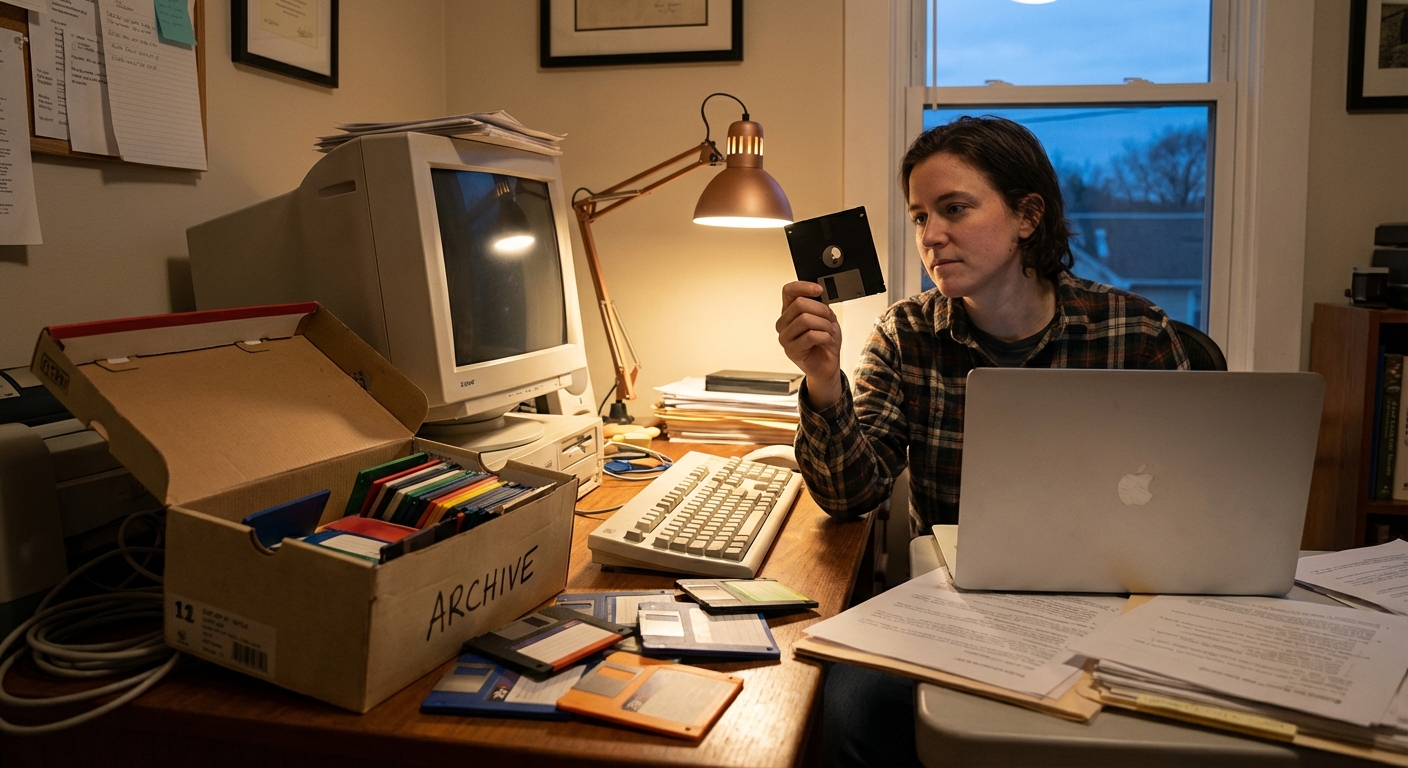
More than one retro-computing fan has a drawer of "mystery floppies." Opening them on a preserved DOS PC is digital archaeology: half-forgotten BASIC programs, high-school essays, long-lost contact lists frozen in time.
Zip Disks: 100 Megabytes of Pure Ambition
The Big Leap
Introduced by Iomega in 1994, Zip disks promised a future beyond 1.44 MB limits:
- Original capacity: 100 MB, later 250 MB and 750 MB versions
- Slightly thicker than a 3½" floppy, but similar footprint
- Proprietary drives connected via SCSI, parallel port, or later USB
For designers, audio producers, and heavy data users, Zip felt like magic.
Zip’s Sonic Personality
Zip drives had a very specific behavior:
- A chunky clack when loading a disk
- A rising whine as the disk spun to speed
- Occasional chirps and grinds as heads sought data
Those sounds reassured you your Photoshop files or Pro Tools sessions were in motion.
The Click of Doom
But there was a dark side: the dreaded "Click of Death."
- Some failing drives would make repetitive clicking sounds
- In the worst cases, they could damage disks permanently
Collectors swap horror stories of entire portfolios locked behind that mechanical failure. Many still keep a "known good" drive around to rescue old projects.
Jaz, SyQuest, and the Age of the Chunky Cartridge
SyQuest Cartridges
Before Zip, there were SyQuest removable hard disk cartridges:
- 44 MB, 88 MB, and larger
- Used heavily in graphics and prepress industries
- Big, sturdy cartridges you’d carry like a mini hardback book
They embodied an era when you physically delivered your files to a service bureau.
Jaz Drives
Iomega’s Jaz took the idea further:
- 1 GB and 2 GB cartridges
- Faster and roomier, used by video editors and professionals
The drives were temperamental, but there was something reassuring about seeing your gigabytes as a tangible object.
Collector Anecdote
Every so often, someone discovers a stack of SyQuest or Jaz cartridges from a defunct design studio. Restoring them involves tracking down a working drive, often from another collector’s stash, and resurrecting not just files but entire visual worlds of logos, layouts, and campaigns.
Optical Curiosities: MO Discs and CD-Rs with Attitude
Magneto-Optical (MO) Discs
Before rewritable CDs and DVDs caught on, magneto-optical systems offered robust, erasable storage:
- Stored data as magnetic patterns altered by a laser
- Common in professional and archival contexts
- Discs often 3.5" or 5.25" in sturdy cartridges
They were beloved for reliability, but never escaped niche status.
Early CD-R and CD-RW
Recordable CDs felt like the future and a luxury at once:
- 650–700 MB per disc
- Early drives wrote at 1x or 2x speed
- Burns could fail if you dared to touch your mouse mid-session
Personalized "burned CDs" became the new mixtape, often decorated with Sharpie art and elaborate printed inserts. Today, people dig them up with tracklists that read like emotional autopsies of entire teenage years.
Why These Dead Formats Still Matter
Physical Anchors to Digital Lives
Each of these formats is a bookmark in digital history:
- 5¼" floppies: text adventures, early word processors, boot disks
- 3½" floppies: shareware culture, school reports, LAN party setup disks
- Zip/Jaz: nascent digital art, multitrack audio sessions, early web design
The files themselves—WordPerfect docs, ancient Photoshop files, MIDI sequences—are often obsolete. But they tell a story about what we cared enough to save.
The Emotional Weight of Small Capacities
When storage was tight, you chose:
- Which files were worth a floppy
- Which photos deserved to live on a CD-R
- Which projects earned a prized Zip disk
Scarcity forced curation. Each disk is a mini self-portrait of priorities at a particular moment.
Rescuing What’s Left
If you’ve unearthed a pile of old disks:
- Don’t toss them yet. There might be treasures inside.
Seek out:
- Vintage-computing communities - Local makerspaces with legacy hardware - Data-recovery specialists familiar with old media 3. Work gently: these drives and disks are fragile elders of the digital age.
Many collectors maintain "bridge machines": old PCs or Macs with both legacy ports (floppy, SCSI, parallel) and some modern interface (USB, Ethernet), acting as translators between decades.
The Quiet Beauty of Obsolescence
We talk about these formats as "dead," but they’re more like retired performers. When you power up an old Zip drive and hear that spin, or gently close the lever on a 5¼" floppy drive, you’re listening to an era when data felt local, finite, and deeply personal.
Today, storage is functionally infinite and placeless. That’s progress—and incredibly convenient—but it’s also why an old floppy with a scribbled label can hit you harder than any login to a cloud archive ever will.
If you’ve still got a box of disks in a closet somewhere, you’re not just hoarding junk. You’re keeping a little museum of how we first learned to store pieces of ourselves in magnetic fields and plastic shells.