Open a cassette shell (carefully) and you’ll find something strangely poetic: a pair of reels, a narrow ribbon of brown tape, and a few tiny rollers and pads. That’s it. And yet, inside that little plastic rectangle lives a whole language—hiss, wow, flutter, dropouts, saturation—that shaped how an entire generation heard music.
Welcome to the Tiny Noisy Universe Inside a Cassette
This is your friendly, slightly nerdy field guide to understanding what’s really happening between those spools.
How Sound Becomes Magnetism (and Back Again)
At the heart of cassette magic is magnetic recording.
- Recording head: A small electromagnet fed with your audio signal.
- Tape: Coated with tiny magnetic particles (iron oxide, chrome, or metal).
- The dance: As the tape passes the head, the changing magnetic field aligns particles in patterns that correspond to the audio.
- Playback: The tape moves past a playback head, which converts those magnetic patterns back into an electrical signal, then into sound.
All of this happens while the tape inches along at 1⅞ ips (inches per second)—slow enough to be cheap and portable, fast enough to sound like music rather than a fax machine.
Hiss: The Friendly Ghost in the Background
What it is: A constant, gentle shhhh you hear during quiet passages.
Why it happens:
- The magnetic particles on tape are never perfectly aligned.
- Even “silence” is a bit noisy at the microscopic level.
- The slow tape speed of cassettes exaggerates that noise.
How the ancients fought it:
- Dolby B/C/S noise reduction boosted high frequencies on record, then lowered them on playback, taking hiss down with them.
- Chrome (Type II) and metal (Type IV) tapes had better signal-to-noise ratios.
To modern ears raised on pristine digital, hiss feels like an error. To cassette lifers, it’s part of the atmosphere—like the murmur of a crowd in the background.
Wow & Flutter: When the Deck Gets Seasick
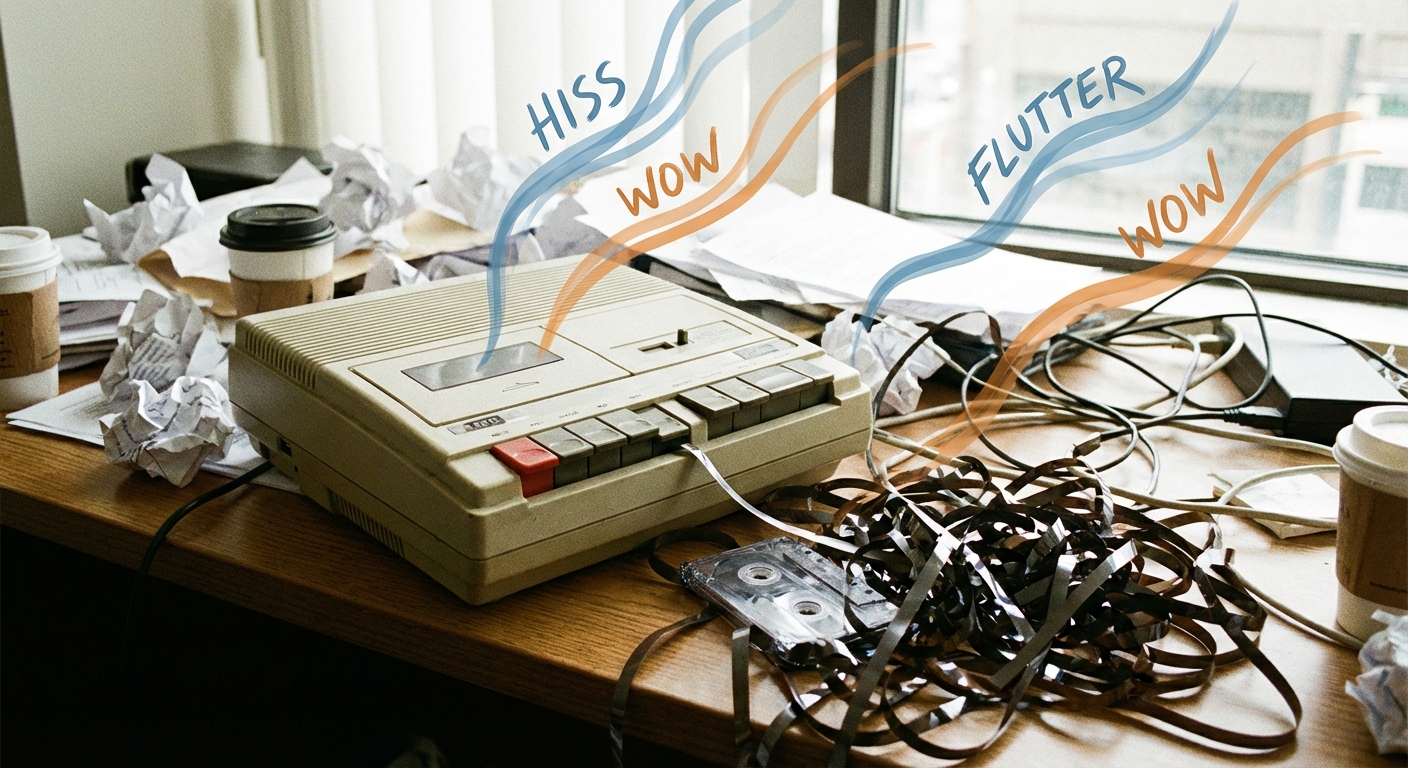
Wow and flutter describe tiny speed variations in the tape’s movement.
- Wow = slower, wandering pitch changes
- Flutter = faster, jittery wobble
Imagine holding a note on a piano while someone gently tugs at the speed control. That subtle warble? That’s wow and flutter.
Common causes:
- A worn or dirty capstan (the spinning metal shaft pulling tape)
- A loose or hardened pinch roller (the rubber wheel pressing tape against the capstan)
- Stiff cassette shells or cheap mechanisms
High-end decks boasted wow & flutter specs around 0.05–0.08%, which is basically invisible in everyday listening. But cheap portables and abused tapes? They’re the ones that made your favorite ballad sound like it was recorded on a boat.
Today, producers sometimes add wow & flutter digitally to make things feel more “tape-like.” Cassette kids smile knowingly.
Dropouts, Print-Through, and Other Tape Gremlins
Dropouts: Little Holes in the Sound
Dropout is when a momentary loss of signal causes a brief dip in volume or clarity—like someone flicked the mute switch for a split-second.
Why it happens:
- Damaged or creased tape
- Dust or dirt blocking tape-to-head contact
- Flaking oxide on old or poorly stored tapes
Collectors often remember these dropouts as part of the song. Hear it on a remastered digital release decades later and you might miss that tiny glitch.
Print-Through: Ghosts of Music Yet to Come
Ever started Side A and faintly heard tomorrow’s chorus bleeding in early? That’s print-through—loud magnetic signals slightly imprinting onto the adjacent layer of tightly wound tape.
On cassettes, it’s usually subtle, but on some old, tightly packed reels, you can hear clear phantom previews.
Saturation: The Sweet Spot Between Clean and Crunchy
Before distortion pedals and plug-ins offered infinite flavors of grit, tape had its own natural way of saying “too much, but in a good way.”
Tape saturation happens when:
- You record too hot (too loud) onto the tape.
- The oxide layer can’t cleanly represent further increases in signal.
Instead of harsh digital clipping, tape compresses and rounds off the peaks, adding harmonics and warmth. Cassette saturation is:
- Less pristine than studio reel-to-reel
- Slightly grainier and more obvious
- Beloved in noisy punk, industrial, and DIY pop
Countless bedroom producers rode their meters into the red, not because they knew the term “harmonic saturation,” but because it felt more alive.
Inside the Cassette: Pads, Guides, and Tiny Engineering Miracles
Pop a cassette open (we both know you’ve done it) and you’ll meet:
- Pressure pad: The small felt pad on a metal spring behind the tape window, pressing tape against the head.
- Guide rollers: Tiny spinning posts that keep tape alignment tidy.
- Shell halves: Two plastic pieces, often held by five screws (if you’re lucky) or welded shut (if you’re not).
Little details that mattered:
- A worn pressure pad can cause muffled sound or channel imbalance.
- Warped shells can lead to skewed tape travel and increased wow & flutter.
- High-end tapes sometimes upgraded pads and rollers for better head contact.
To a casual listener, a cassette was a cheap rectangle. To an obsessive, it was a precision device… inside a cheap rectangle.
The Four Tribes of Tape: Type I, II, III, IV
Every tape nerd has a favorite species.
- Type I (Normal/Ferric)
- Warm, slightly rolled-off highs
- More hiss, but forgiving
- Great for rock, punk, and spoken word
- Type II (Chrome / Cobalt)
- Brighter, clearer treble
- Lower hiss, better for detailed music
- The go-to for many mixtape makers
- Type III (FeCr)
- Short-lived experiment mixing ferric and chrome
- Rare, somewhat fussy about deck compatibility
- Type IV (Metal)
- Highest output and dynamic range
- Punchy bass, crisp highs
- Overkill for some decks, beloved by hi-fi fans
Decks with manual tape-type switches felt like command centers: you weren’t just recording—you were choosing a side in a friendly format war.
Why These Imperfections Still Feel So Right
Streaming is gloriously clean, but it’s also weirdly frictionless. Cassettes, by contrast, insist on being things:
- You flip the tape. You commit to a side.
- You hear the hiss and know you’re in real time.
- You recognize your own copy by its quirks: that wobble on track three, the tiny dropout right before the chorus.
These sonic fingerprints turned every cassette into a one-of-one artifact, especially once it aged. The language of hiss, wow, and flutter ended up being the accent of an entire era.
Learning to Listen with Tape Ears
Revisiting cassette culture today means listening a bit differently:
- Notice the noise floor as part of the room, not an intruder.
- Hear small warbles as signs of the machine doing its best.
- Embrace distortion and saturation as expressive colors, not only technical flaws.
Inside every cassette is a tiny battlefield of physics and music—and somehow, remarkably often, the music wins.
So the next time you press play on a tape and hear that soft rush of hiss before the first note, take a moment. That sound is the threshold between silence and memory, between plastic and feeling.